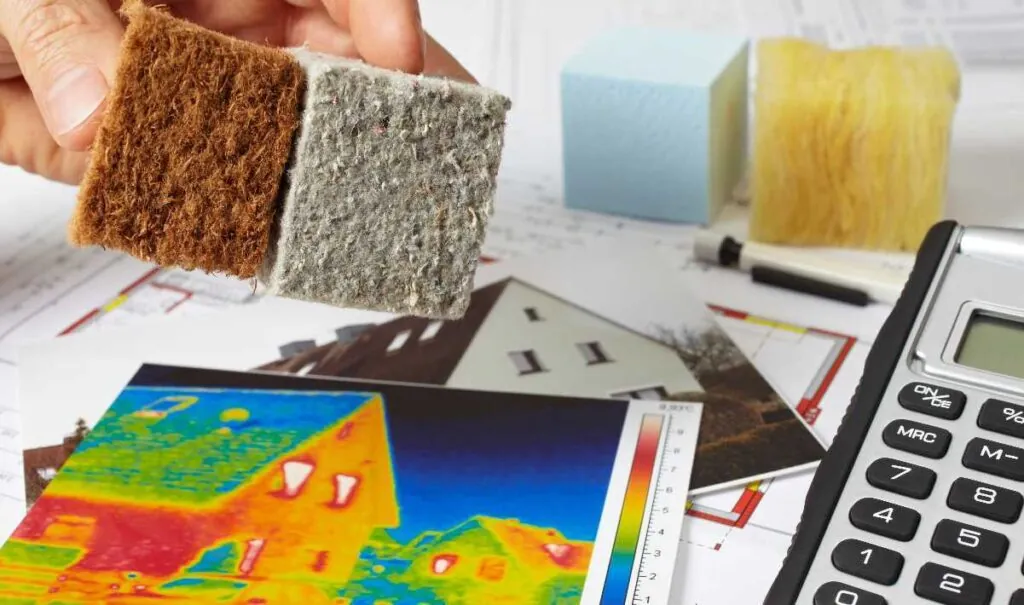
Energy-efficient buildings are advertised as having solar panels, smart thermostats, and high-efficiency HVAC equipment. Too often, though, many Virginia homes can have every one of these upgrades and still bleed energy through an under-insulated attic or a leaky rim joist.
Here’s the reality: more than half of a typical U.S. household’s annual energy use goes to heating and air conditioning. In Lynchburg and central Virginia’s mixed-humid Climate Zone 4A, that number rides on how well your home holds the air you’ve already paid to condition. A high-efficiency furnace can’t recover heat escaping through your ceiling.
Insulation — combined with air sealing and properly installed for our humid summers and sub-freezing winters — is the highest-leverage energy-efficiency upgrade most Virginia homeowners can make. Understanding the current Virginia insulation code requirements is the right place to start with every energy-efficient building design in Virginia.
What Energy-Efficient Buildings Look Like in Virginia
An energy-efficient home in Virginia delivers the same comfort — steady temperatures, manageable humidity, good air quality — using less purchased energy than a conventional one.
Four elements make that happen:
- A tight, well-insulated envelope
- A right-sized, high-efficiency HVAC unit
- Controlled ventilation
- Efficient lighting and appliances
Of those four, the building envelope is the only one that works around the clock, every day of the year, on every form of energy your home uses, whether electric, natural gas, propane, or heat pump.
Lynchburg and most of central Virginia are in IECC Climate Zone 4A, classified as mixed-humid. That means real heating loads from late October through March, serious cooling loads from May through September, and elevated summer humidity. Your insulation needs to handle heat flow in both directions while resisting moisture.
Where the Energy Goes — and How Insulation Stops the Leak

According to the U.S. Energy Information Administration, space heating and air conditioning account for roughly 52% of a typical American household’s annual energy consumption. Residential energy consumption in Virginia leans slightly heavier on cooling than the national average. That means every dollar of conditioned air lost through your ceiling or rim joist comes straight out of the largest line item in your energy budget. Improving your building envelope delivers a greater return on investment than almost any other efficiency upgrade.
How Insulation Carries the Load
Insulation slows heat transfer by keeping conditioned air inside the thermal boundary longer. This measured resistance to heat flow is an insulation’s R-value: the higher the R-value, the more resistance per inch.
ENERGY STAR estimates that combining air sealing in Virginia homes with added insulation in attics, floors over crawl spaces, and accessible rim joists saves homeowners an average of 15% on heating and cooling costs — about 11% on total energy costs. For most Lynchburg-area homes, attic insulation services are among the best retrofit targets available.
What the 2021 Virginia Code Now Requires
Virginia’s residential energy code is the 2021 Virginia Residential Code (VRC), part of the Virginia Uniform Statewide Building Code. It took effect January 18, 2024, and all new residential permits have been required to comply since January 18, 2025.
The biggest change is the ceiling insulation requirement. For vented attics in climate zones 4 and 5, Virginia now mandates R-60 attic insulation (up from the previous R-49), or roughly 18 to 20 inches of blown-in insulation in central Virginia homes. The 2024 International Residential Code moved back toward R-49, but Virginia kept the higher bar. All new construction and major renovations in Lynchburg are permitted to that standard.
Most central Virginia homes built before 2010 have attic insulation levels ranging from R-19 to R-38, which is well below today’s target. That gap is the biggest reason older homes feel drafty in February and overworked in August despite a functional HVAC unit. Many homeowners choose spray foam insulation for their Lynchburg area home because it seals and insulates in one easy application, especially at rim joists and rooflines.
Frequently Asked Questions
Q: What makes a home in Virginia “energy efficient”?
An energy-efficient home in Virginia delivers the same comfort with less purchased energy. For Virginia’s climate zone 4A, covering Lynchburg and most of central VA, the foundation is a tight, insulated, and air-sealed envelope with a properly sized HVAC unit, controlled mechanical ventilation, and efficient lighting and appliances. The 2021 VRC defines the prescriptive targets for new construction.
Q: What R-value does Virginia code require in the attic right now?
The 2021 Virginia Residential Code insulation standard for vented attics in single-family homes is R-60 (for both climate zones 4 and 5). That is roughly 18 to 20 inches of blown-in fiberglass or cellulose. Virginia kept R-60 even after the federal 2024 International Residential Code (IRC) moved back toward R-49. Requirements for unvented attics differ, so confirm with your local building official or contractor.
Q: How much can insulation save on a Virginia energy bill?
ENERGY STAR estimates an average 15% cost reduction in heating and cooling energy use in Virginia — about 11% on total energy costs — when air sealing is paired with added insulation in attics, floors, and accessible rim joists.
Q: Is insulation worth it in an older Lynchburg-area home that already has some?
Almost always. Most central VA homes built before 2010 have ceilings rated R-19 to R-38, well below the current R-60 target. Adding insulation on top of existing material is one of the lowest-cost, highest-return retrofits available, with savings that compound every season.
Q: Does insulation matter as much as a new HVAC system or windows?
For most homes in Climate Zone 4A, insulation and air sealing in Virginia homes deliver more savings per dollar than HVAC or window replacement, especially when your existing HVAC system is functional. Insulation works every day with no moving parts, and new equipment simply performs better when the envelope is already tight.
Make Insulation the Foundation

Energy-efficient homes and buildings in Lynchburg, Virginia, aren’t a label. They’re the result of a system — envelope first, then equipment, then controls — designed and installed for the specific demands of central Virginia’s Climate Zone 4A. The 2021 Virginia Residential Code sets the benchmark every retrofit should be measured against. Insulate first, air-seal throughout, and the rest of your home will perform the way it was designed to.
Toler Insulating has served Lynchburg and central Virginia homeowners for over 30 years. We install a full range of insulation services — spray foam, fiberglass, and cellulose — and our team will show you where the highest-return upgrades are in your home. Contact us online today or call (434) 239-8590 to schedule your free assessment.
References
ENERGY STAR. “Methodology for Estimated Energy Savings from Sealing and Insulating.” U.S. Environmental Protection Agency, www.energystar.gov/saveathome/seal_insulate/methodology.
ICC Digital Codes. “2021 Virginia Residential Code.” https://codes.iccsafe.org/content/VARC2021P2/chapter-11-re-energy-efficiency#VARC2021P2_Ch11_SecN1102.1.3
Pacific Northwest National Laboratory. “Climate Zone Map from IECC 2021.” Building America Solution Center, U.S. Department of Energy, https://basc.pnnl.gov/images/climate-zone-map-iecc-2021.
U.S. Department of Energy. “Building America Climate-Specific Guidance.” Building America, https://www.energy.gov/cmei/buildings/building-america-climate-specific-guidance
U.S. Department of Energy. “Insulation.” Energy Saver, www.energy.gov/energysaver/insulation.
U.S. Energy Information Administration. “Household Energy Use in Virginia.” U.S. Department of Energy, www.eia.gov/consumption/residential/reports/2009/state_briefs/pdf/va.pdf.
U.S. Energy Information Administration. “Use of Energy in Homes.” U.S. Department of Energy, www.eia.gov/energyexplained/use-of-energy/homes.php.
Virginia Department of Housing and Community Development. “Virginia Uniform Statewide Building Code (USBC).” Commonwealth of Virginia, www.dhcd.virginia.gov/virginia-uniform-statewide-building-code-usbc.